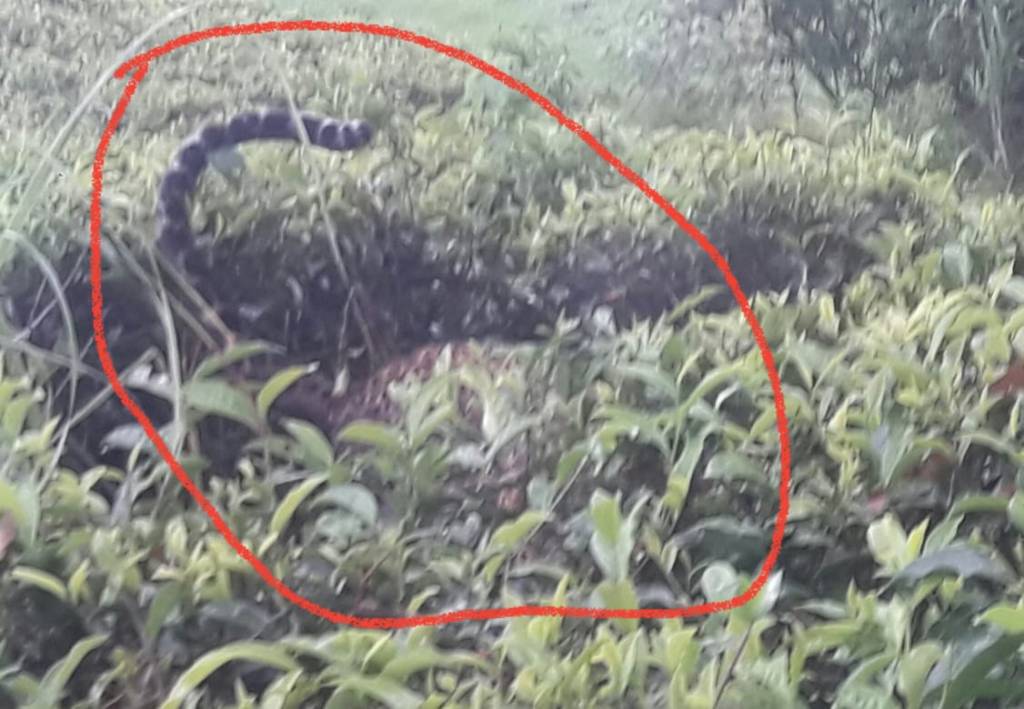
A leopard trapped in a snare at Kotiyagala Estate, Bogawanthalawa rescued and released to a natural habitat, today. Friends of Horton Plains was informed this incidence by the community group and we informed officials of Dept. of Wildlife Conservation, immediately.
Mr. Mihiraj Samaraweera, Senior Manager, Kotiyagala Estate, Bogawanthalawa and the management of Kotiyagala Estate were actively involved to control the community and keep people away from the trapped leopard, till officers of DWLC reach. Due to the commitment of Management of the estate, the leopard was rescued and released to suitable natural habitat by team of DWLC.
Friends of Horton Plains highly appreciate the leopard rescue mission led by Mr. Mihiraj Samaraweera, Senior Manager and Vice President of Friends of Horton Plains and following persons Mr. Rehan Madena, Snr. Asst. Manager, Mr. Amila Jayaweera, Asst. Manager, Mr. K. Kannadasan, Field Officer Chapelton Division, Trade Union leaders, Volunteer team and workers of Kotiyagala Estate and Mr. Damiyan, Group leader of Youth Ambassadors program, Bogawanthalawa Estate.
The Sri Lankan leopard and human have coexisted in the Central Highland for a longer period but incidences between leopard and human were less. However, in the last two decades, anthropogenic activities and the behavior of humans have had a negative impact on the leopard population in the hill country. The mortality of hill country leopards has increased due to illegal activities in tea plantation ecosystem.
Recently, within three days, a leopard was rescued while one died in the tea plantation ecosystem, Central Highland, Sri Lanka. Former leopard was trapped in a house at Logi Estate, Talawakelle and rescued by the team of Department of Wildlife Conservation on 5th August, 2022 and released to natural habitat. The owner of the house and neighbors were appreciated by the general public due to their cooperation shown with relevant authorities.
A leopard trapped in a house rescued
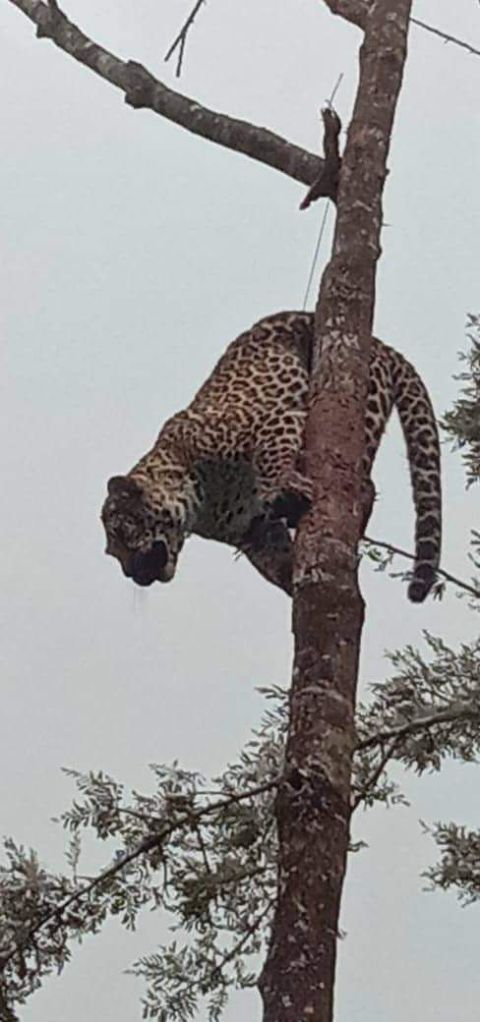
Another Sri Lankan leopard had been trapped in a snare on 7th August 2022 near Hatton. Then, the leopard climbed a Gravillia tree along with a trapped cable and hung on a branch. Unfortunately, after a couple of hours, the leopard died.
Based on prolonged observation done by Friends of Horton Plains, a non-profit organization, many human-leopard incidences have been recorded. These incidents resulted higher mortality percentage of Sri Lankan leopards due to illegal trapping, snares and poison baiting. In addition to several awareness programs to estate community,
In addition to several community based awareness programs, another webinar was jointly organized by the FOHP and ASLM to management of tea estates on 15th August, 2022. During the webinar, resource person Mr. Rukshan Jayawardene, a founding trustee at the Leopard Trust, explained the behavior of leopards in high altitude and the importance of an apex predator to smooth functioning of the ecosystem.
During the discussion, Mr. Rajika Gamage, FOHP explained the effectiveness of recently concluded Phase I of “Misty Hills – Youth ambassador programs” conducted by Friends of Horton Plains. These programs were facilitated by Alliance for Sustainable Landscape Management (ASLM) and Rainforest Alliance. Several Estate Managers including Hatton Plantations, Bogawanthalawa Plantations, Mathurata Plantations and Kelani Valley Plantations explained the conservation activities conducted by trained youth groups in their estates. Mr. Dasun Jayasinghe, Standard & Assurance Consultant for South Asia, Rainforest Alliance, pointed out the importance of community empowerment through awareness programs to mitigate such encounters.
Mr. S. Nandakumar, President FOHP discussed the removal of snares followed by successful awareness programs in Thangakelle Estate to reduce human-leopard incidences. The importance of supplying electric fencing to farmers was pointed out by Mr. Mahendra Prasad Pieris. Mr. Giri Kadurgamuwa, ASLM thanked to FOHP to conducted such important awareness programs. All participants were requested to conduct conservation activities such as removal of snares, stop hunting etc. at their estates.
Today 1st August, 2022, Sri Lanka will celebrate its first national day of the Sri Lankan leopard. It was declared based on a proposal put forward by the Wildlife and Nature Protection Society (WNPS), Sri Lanka. The Sri Lankan leopard subspecies (Panthera pardus kotiya), up until 2020, was an endangered species. In 2020, the International Union for Conservation of Nature (IUCN) declared present status as “vulnerable” on their international Red List of Threatened Species.
Foot-print of leopard. Pic taken by Rajika Gamage
Many areas inhabited by leopards both in wet and dry areas of Sri Lanka. Recent observations revealed that the leopards use a range of landscapes in Central Highlands, Sri Lanka including regenerating forests, tea plantations and other areas in close proximity to human settlements. As human populations continue to increase and reduction of natural habitats in hill country, the incidences of human-leopard encounters have been increased in recent past. Due to lack of awareness of the behavior of leopard in hill country, these incidences lead to conflicts.
Carcass of lapboard
With prolong observation of leopard killing in Central Highlands; the environment association named “Friends of Horton Plains (FOHP)” conducted several community based awareness programs during last couple of years. A brain-storming session was organized by the FOHP collaboration with Department of Wildlife Conservation and Wildlife & Nature Protection Society of Sri Lanka on 16th May 2018. During the meeting, several key decisions were taken for future activities of leopard conservation in Central Highland landscape.
Community awareness programs conducted by Rajika Gamage, FOHP
Friends of Horton Plains organized online lecture series conducted by Mr. Rukshan Jayawardene, under the theme of “Human-leopard co-existence in the tea landscape in Central Highland, Sri Lanka” in 2020. Based on the outcomes of the lecture series, the association formed several community youth groups in hill country tea estates. Selected youth groups were empowered through awareness programs to conserve this important large carnivore in Human dominated tea landscape.
Field activities conducted by Rajika Gamage, FOHP
The association successfully concluded Environmental Stewardship community program named “Misty Hills – Youth Ambassador Program” partnership with Alliance for Sustainable Landscape Management during year 2021 and 2022. FOHP trained total of 250 youths from selected youth groups as “Young Naturalists” along with officials of tea estates in six different regions in Central Highland, Sri Lanka. It is observed that, with the success of the community based awareness programs, the incidences of leopard killing in tea landscape in Central Highlands has been greatly reduced.
Several residential youth naturalists training programs have been successfully completed by Friends of Horton Plains collaboration with Rainforest Alliance in 2021. All programs were conducted by the naturalists of Friends of Horton Plains at the Horton Plains National Park.
View from Thotapola Kanda
Two residential programs at Horton Plains National Park
Youth groups from different tea estates viz. Dayagama West, Tangakelle, Uvahkelle, Laxapana, Moray, Fairlawn, Alton & Strathsphy Estates were participated for the first two residential programs. Several nature conservation activities such as identification of Sri Lankan flora & fauna, importance of natural ecosystems and services, impact of invasive species, development of leadership were conducted by the experts of Friends of Horton Plains. Several officials from Rainforest Alliance also participated and certificates were distributed.
Two residential programs for Bogawanthalawa Region
Based on the successfully completed previous programs, Friends of Horton Plains organized another Youth Nature Ambassadors program collaboration with Rainforest Alliance for youth groups in Bogawanthalaa, Kotiyagala, Campion, Fetteresso, Bogawana and Loinorn tea estates under Bogawanthalawa Plantation Plc.
Field activities
Identification of different forest types
Different ecosystems in Central Highland and their importance
Field identification of animals through visual observation (butterflies, dragonflies, amphibians, mammals and plants)
Team work and leadership development
Presentations and distribution of awards and certificates
In Sri Lanka, Orchidaceae is among the largest families in the country with 189 known species, belonging to 78 genera, including 55 endemic species. Considering the Sri Lankan orchids, 70.6% of the orchid species including 84% of the endemics are categorized as threatened. Within this 8.6% of the species are Critically Endangered (CR), 29.3% are Endangered (EN) and 32.6% of species are Vulnerable (VU). Further, 2.2% of the species are Critically Endangered Possibly Extinct [CR(PE)], 14.1% are Near Threatened (NT).
Ipsea speciosa
Among terrestrial orchid species, the Daffodil Orchid (Ipsea speciosa)has identified as an endemic and endangered species. It is hard to distinguish this species among grasses when there are no flowers as it does not bear leaves during the flowering season.
Some species of orchids are specialized to grow in wet habitats; Habenaria and Peristylus prefer growing in wet seepage areas where as Ipsea speciosa, Phaius wallichii and Satyrium nepalense recorded in patana grasslands in lower montane and upper montane zones
Satyrium nepalense
Threat and conservation
Habitat deterioration and degradation, clearing of vegetation, intentional forest fires and spread of invasive alien species are significant threats to highland grasslands and wetlands in Sri Lanka. In the montane and submontane areas, forests and grasslands are cleared for vegetable cultivation, this being the main agriculture-based threat. The excessive use of agro chemicals is believed to have a considerable impact on the survival of the orchid populations. Besides, forest felling for firewood, encroachments and illegal settlements, intentional forest fire and garbage dumping are the main habitat related threats to native orchid survival.
References
Fernando, R.H.S., 2012. Present status of family Orchidaceous in Sri Lanka, in: Weerakoon, D.K., Wijesundara, S. (Eds.), The National Red List 2012 of Sri Lanka: Conservation Status of the Fauna and Flora. Ministry of Environment, Colombo, Sri Lanka, pp. 200–204.
Fernando, S. S.
& Ormerod, P. (2008). An annotated checklist of the Orchids of Sri Lanka. Rheedea,
18(1), 1–28.
Wetlands are habitats with either permanent or temporary accumulation of water, with associated floral and faunal communities. They are valuable in terms of hydrology, plant and animal productivity, and biodiversity; and they carry out important functions, especially for sustaining hydrological and chemical cycles.
The National Wetland Directory of Sri Lanka in 2006, in which 62 wetlands have been described with their status. According to the Ramsar definition, three major categories of wetlands can be identified in Sri Lanka.
(i) Inland natural freshwater wetlands
(ii) Marine and salt water wetlands
(iii) Man-made wetlands
Manmade lake in tea estate
Hydrological
Importance of central highlands
The highland wetlands can be classified based hydrological and ecological features or functions that contribute, to development of ecological communities. Freshwater marshes and water logged swamps are shallow inland depressions either connected to a river or receive water through surface run-off, river floodwater and ground water seepage. In general, highland marshes are seen in the valleys and lower slopes. These habitats are associated with grasslands and are good examples of unique ecosystems found only in hill country of Sri Lanka. Montane grassland marshes are best represented at Horton Plains National Park at an altitude of about 2000 m . Most of the threatened highland crabs and amphibian species are associated with the aquatic ecosystems such as marshy lands.






 Sri Lanka - Wonders of biodiversity